
Winged Beans: Why aren't more people growing these things?
Every now and then, we stumble across something in the gardening world that makes us wonder why we've never heard more about it. That's pretty much how we feel about Winged Beans.
First off, these things look downright strange... Imagine a green bean that decided it needed four frilly edges running down its entire length. That's a winged bean. But the more we learned about them, the more interested we became. Not because they're unusual looking, although that's certainly part of the fun, but because of just how useful this plant can be on a Homestead.
And here in Florida, where summer gardening sometimes feels like trying to grow vegetables on the surface of the sun, we're always interested in plants that actually enjoy the heat.
So... what exactly is a Winged Bean?
Winged bean (Psophocarpus tetragonolobus) is a tropical climbing plant that's been grown in parts of Asia and the Pacific for generations. It's a legume, just like regular beans and peas, but it has a few tricks up its sleeve that make it a little different from what most of us are used to growing.
For starters, almost the entire plant is edible and we really do mean almost everything!
The young pods can be cooked like green beans, the leaves can be used as cooking greens, the flowers are edible, the seeds can be harvested and some varieties even produce edible tuberous roots!
Think about that for a minute... one plant can potentially give you several different kinds of food, all while growing vertically instead of taking up a huge section of your garden. That's the kind of thing that gets our attention around here.
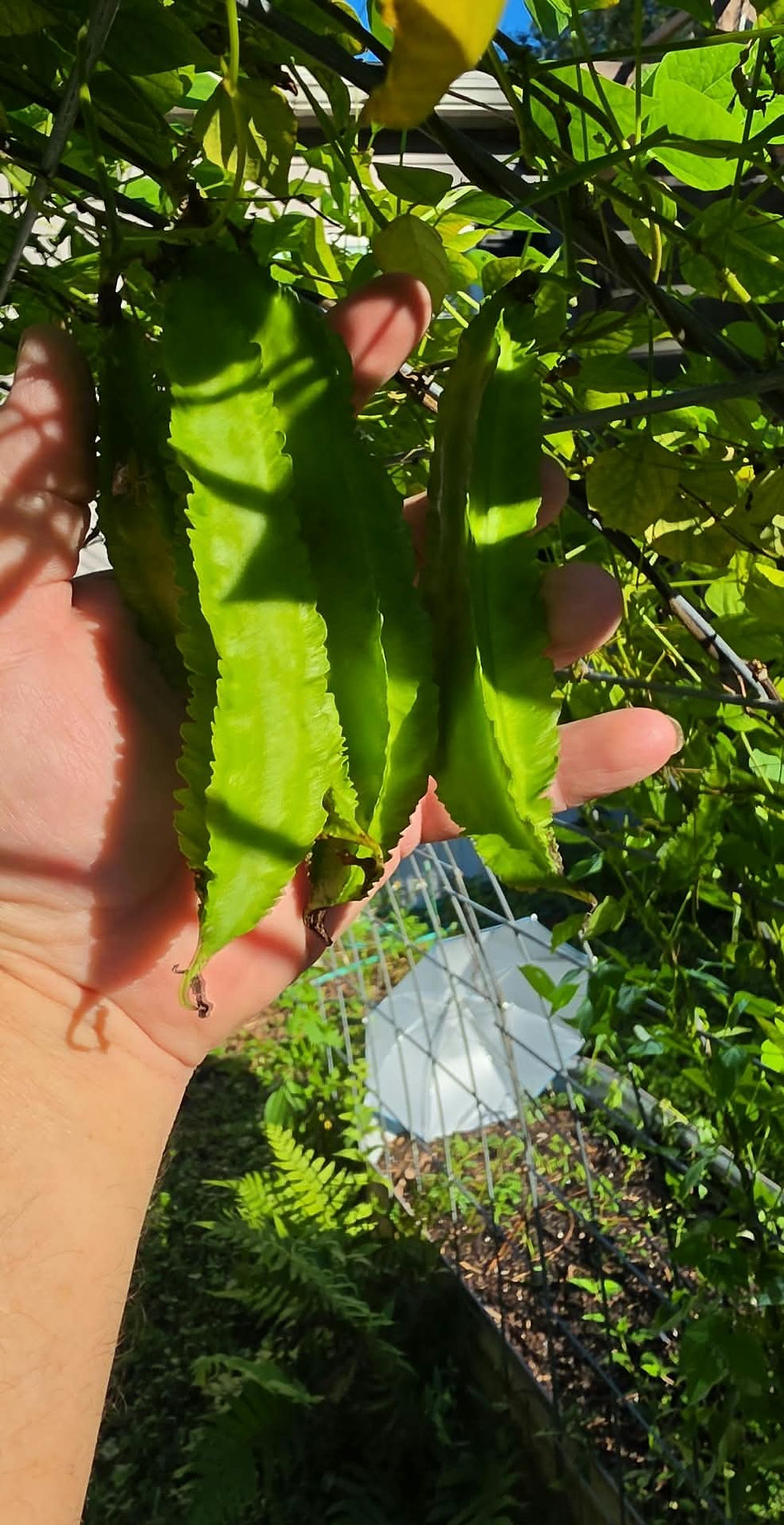
You can eat more than just the Beans
Most of us plant Green Beans because, well, we want Green Beans but with Winged Beans, you've got options. The young pods are probably the most familiar part. They're tender when picked early and have a mild, slightly nutty flavor and you can toss them into a stir-fry, saute them with garlic, steam them, or use them in soups. The leaves can be cooked much like spinach or other leafy greens, and the flowers are edible too. If you let the pods mature, you can harvest the dried seeds and cook them like other dry beans. Then there are the roots. Under the right conditions, some winged bean plants develop enlarged roots that can be harvested and cooked as food.
Now, that doesn't mean every Winged Bean plant is going to produce a big crop of everything. Variety and growing conditions make a difference, but we love the idea of growing something that gives us more than one harvest option.
One important thing to mention: mature seeds and edible roots need proper cooking. Like many legumes, Winged Beans contain naturally occurring compounds that make eating them raw a bad idea.

Don't wait too long to pick them
Here's something worth knowing before you plant these. If you want tender pods, pick them young because as Winged Bean pods mature, they get tougher and more fibrous. Eventually, they're better suited for producing seed than for eating as a vegetable and in warm weather, things can move pretty quickly.
You know how Zucchini can go from a perfectly reasonable vegetable to something the size of a small canoe when you turn your back? Same general idea LOL
Check your vines regularly and pick the pods while they're still young and tender. If you miss a few, no big deal. Let those mature and save the seeds.
They're pretty impressive nutritionally too
Now, here's something that really caught our attention. Winged Beans aren't just another unusual vegetable to grow for the fun of it. They're actually quite nutritious, and depending on which part of the plant you're eating, they offer some different benefits.
The young green pods are low in calories and provide Fiber, Vitamin C, Folate and Minerals like Calcium and Iron. They're a great way to add some variety to your vegetables without adding a lot of calories.
The mature beans are where things get really interesting. Dried Winged Bean seeds can contain around 30–40% protein by weight, putting them in the same general league as Soybeans and that's considerably more protein than you'll find in most common vegetables.
They also contain roughly 15–20% fat, much of it unsaturated, along with Fiber, Phosphorus, Magnesium, Iron and other Minerals.
Unlike many vegetables, Winged Beans provide meaningful amounts of all nine essential Amino Acids. That doesn't make their protein identical in quality to animal protein, but it does make them an interesting plant-based protein source.
The leaves bring something different to the table. Like many dark leafy greens, they provide Vitamins, Minerals and beneficial plant compounds, including Carotenoids and even the tuberous roots can contribute carbohydrates and some protein, although their nutritional composition varies considerably depending on the variety.
What's especially interesting to us is that we're talking about several different kinds of food coming from one plant: Fresh vegetables, cooking Greens, protein-rich dried Beans, and potentially edible roots and for anyone trying to grow more of their own food, that's a pretty appealing combination.
Of course, there's one important detail. Mature winged beans need to be thoroughly cooked before eating. Like Soybeans and many other legumes, they contain naturally occurring antinutritional compounds, including trypsin inhibitors, that can interfere with digestion and nutrient absorption when improperly prepared. So while they're nutritious, proper preparation matters!
And that's really what makes Winged Beans so interesting from a Homesteading perspective. We feel, they can be reasonable described as Superfood since they are an incredibly versatile crop that can provide several different nutritional benefits from the same growing space.

Here's where Florida Gardeners need to pay attention
Winged Beans love warm weather, which sounds like a perfect match for Florida.
But there's one little catch that can drive Gardeners absolutely crazy...
Some winged bean varieties won't flower until the days get shorter!
So you can spend the entire summer watching this beautiful, healthy vine climb all over your trellis, putting out leaves like there's no tomorrow and producing absolutely nothing you can pick. Meanwhile, you're standing there wondering what on earth you're doing wrong.
Turns out, it might not be anything you're doing! Some traditional Winged Bean varieties are sensitive to day length, meaning they wait for shorter days before they start flowering.
That's not exactly ideal if your growing season ends before the plant gets around to making Beans LOL but fortunately, there are varieties that are less sensitive to day length.
If you're planning to grow Winged Beans, especially here in North Florida, look for seeds described as day-neutral or early flowering. That little detail could make a big difference in whether you end up with an actual harvest or just a really impressive wall of greenery.
Give them room to climb
Winged Beans aren't little bush plants that politely stay where you put them. They're vines, and they can get pretty enthusiastic about climbing and a sturdy trellis, cattle panel, fence, or arbor is a good idea. We put ours on a Cattle Panel Trellis.
They prefer full sun, warm temperatures, decent drainage, and consistent moisture. They're also legumes, which means they can work with certain soil bacteria to fix atmospheric nitrogen.

That doesn't mean they'll magically fertilize everything around them, but it's another interesting characteristic of the plant. We like crops that do more than one job, whether that's feeding us, attracting beneficial insects, providing shade, or contributing to a healthier growing system. And Winged Beans have the potential to fit into several of those roles.
Why do we grow them?
We're always looking for plants that make sense for our climate instead of constantly fighting against it. Don't get us wrong... we love our traditional garden vegetables, but Florida has a way of reminding you that not everything appreciates months of heat, humidity and afternoon thunderstorms.
Sometimes the smartest thing you can do is stop trying to force a plant to tolerate your growing conditions and start growing something that actually likes them which is certainly one reason we're so interested in tropical and subtropical food crops and Winged Beans check quite a few boxes.
They're unusual, they're useful, they're nutritious, and they don't need a huge amount of ground space if you've got something for them to climb plus, we'd be lying if we said we didn't enjoy growing things that make visitors stop and ask, "What in the world is THAT?"
Those are usually some of our favorite plants.

A little more than just another Bean
The longer we Homestead, the more we realize there's an incredible amount of food out there that most of us simply weren't raised eating or growing. Most of us tend to stick with what's familiar. Tomatoes, Cucumbers, Peppers, Squash, Green Beans and there's nothing wrong with any of those.
But there's a whole world of edible plants beyond the usual seed rack at the garden center.
Some won't work for our climate. Some aren't worth the effort. And some turn out to be absolute gems. We made it a habit of introducing 2-3 plants every year into our Garden that we have never grown before. If we like them, they go into our Crop rotation, if we don't... we just don't plant them again and Winged Beans are one of those plants we think deserve a closer look.
Will they replace our regular green beans? Maybe, maybe not. But could they earn a permanent spot in our garden? Quite possibly. And that's part of what we enjoy about Homesteading. We're constantly learning, experimenting, figuring out what works, and occasionally wondering why nobody told us about something sooner!
Have you ever grown Winged Beans? We'd love to hear how they did for you, especially if you're growing them here in Florida!


Comments